
This year, Dyslexia Awareness Week is taking place from 6–12 October England, Wales and Northern Ireland, and 29 September to 5 October in Scotland. The theme this year is all about ‘Raising the volume’ to add our voices together and build momentum for change!
To raise the volume on dyslexia, Jamie Oliver and the Bristish Dyslexia Association have joined forces to launch the UK’s first ever voice petition – the message is simple but urgent calling for early screening for all children in our schools and to support teachers with the training and resources they need to help every child.
The campaign is designed to keep pressure on Education Secretary Bridget Phillipson as she prepares her long-promised reforms to the SEND system.
So now is the time to speak up and use my voice to #RaiseTheVolume on dyslexia – here’s my voice:
If you want to share your voice too, you can:
#RaisingTheVolume #DyslexiaRevolution #MyDyslexiaStory 📣
About Dyslexia ℹ️

Dyslexia is often called a ‘hidden disorder’ because, despite being so common, it is poorly understood. It is estimated that as much as 10% of the population are believed to have dyslexia. In the UK that would equate to 6.3 million people! However, there continues to be a lack of understanding about dyslexia.
Everyone with dyslexia has a unique story – you can read mine below plus if you want to learn more about my challenges with dyslexia – including in the workplace, take a look at my blog posts here Dyslexia – My Super Power and Celebrating Neurodiversity. 📣
Dyslexia in adulthood 💼
Anyone who has dyslexia has unique strengths and challenges. One of the most common myths I hear from people is that you grow out of it – but you can’t it’s simply a lifelong condition…
Life would be much easier without it!
3.3 million adults in the UK workplace have dyslexia – that makes me feel a bit better and not alone but there is still a lack of awareness and why as adults don’t we talk about it as much? Especially when it doesn’t just go away!
I have to admit, there has been many a time during my working career that I’ve kept my dyslexia hidden and been afraid to share it with both managers and colleagues in the work place. Why you ask? I think it’s a confidence thing and as usual with most people who have a neurodiversity – people don’t understand it or have the time to either.
So why now am I talking about dyslexia? Because we need to champion neurodiversity in the work place as that will make life easier for the next generation of workers. Making small adjustments within my working environment has made such a difference to me already. Adjustments such as my working hours (making more flexible), taking regular screen breaks (going for runs), using tools for better organisation, planning and communication plus taking the time to talk to colleagues and use support networks available at work has all helped.
As a starting point, I’ve found these guides extremly useful:
- Top tips for adults | British Dyselxia Association
- Top tips for employers | British Dyslexia Association
So what would I say to any adult in the workplace who has dyslexia? Embrace it and re-visit your dyslexia again – it not only helps you to think differently at work but also helps you to understand the reasons why you may do things and behave in certain ways. 📣
Believing in Yourself 🙌
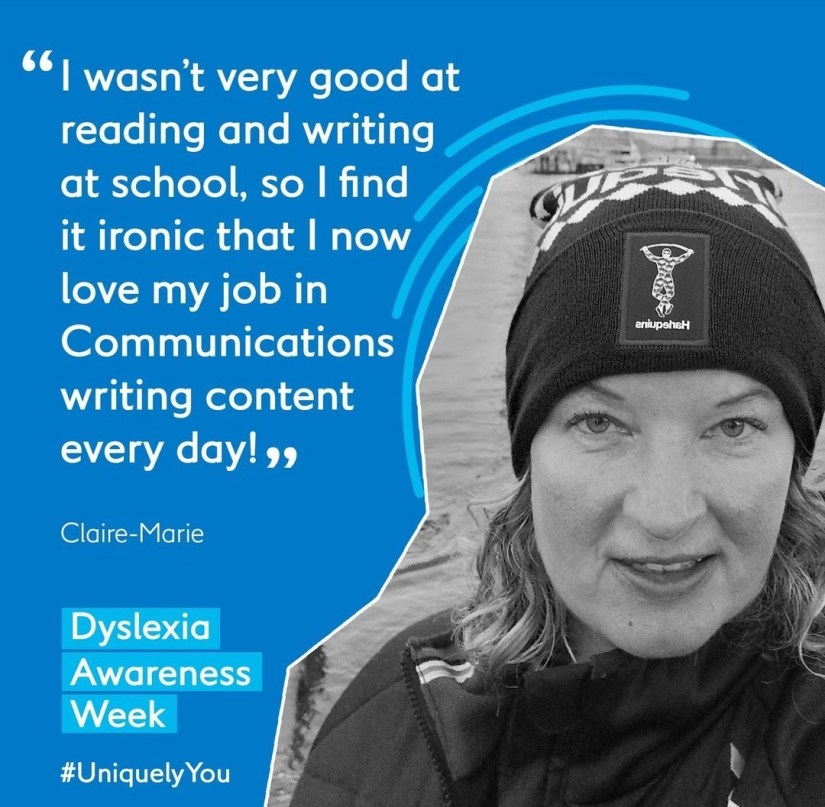
I was about 8 years old, having just started junior school when teachers thought I may be dyslexic. I remember struggling with schoolwork especially reading and writing and feeling a little worried that I was finding everything harder than my friends at school. I felt like everyone thought I was being lazy – but things just took me a little longer.
From an early age, I really had to work at both skills. By the time I was ten, I was diagnosed as being dyslexic and was lucky enough to have a ‘one to one’ support lesson each week with a lady I still remember fondly as ‘Mrs Brown’. We got on famously in particular when I received 20 smiley faces for good work and a tube of chocolate smarties!
I remember my parents being told that unless I got the support I needed, I wasn’t going to do well in my GSCE’s, especially in English.
I was one of the lucky ones, getting the support I needed throughout my studies in the form of tuition, equipment and extra time in my exams. 📣
What makes you, uniquely you? 💙
Anyone who has dyslexia has unique strengths and challenges. It impacts your reading, writing, spelling and memory.
Despite my Dyslexia diagnosis, I went on to achieve my GCSE’s, A-Levels and a 2:1 BSC degree.
Throughout my studies I received the support I needed in the form of tuition, equipment and extra time in my exams.
I’ve never let dyslexia hold me back – my family put it down to sheer determination to prove myself and I put it down to Mrs Campbell, my headmistress at junior school who always told me that there was no such word as ‘can’t’ only ‘can’ if you believe in yourself.
What makes me unique? I’m a self confessed content guru! I love writing about anything and everything and although I’m reminded of my dyslexia everyday it doesn’t stop me! I write my own blog and I ’d love to have a go at writing a kids book one day. 📣
Raising Awareness 💬
It is important to raise awareness of dyslexia because it helps break down those barriers and shares the issues and struggles that dyslexic people face daily. Dyslexia has and still does impact my everyday life in both positive and negative ways. It’s for life and doesn’t just go away – you just find ways to make life easier!

I must work hard at everything, some tasks can take me a while to complete and I still make mistakes but thankfully with the help of colleagues/friends and loved ones, I can spot them and quickly put them right! Dyslexia also effects my confidence and my self-belief.
The positives are that I have a fantastic long term memory because when I need to learn/remember something it’s ingrained in my memory!
I’m also very creative, hardworking and determined – all skills which my dyslexia has driven and ones which I’m grateful for because without being so, I wouldn’t be where I am today. 📣
Learn more about dyslexia 📖
Take time to learn more about dyslexia:
 #MyWorld